DMR Introduction
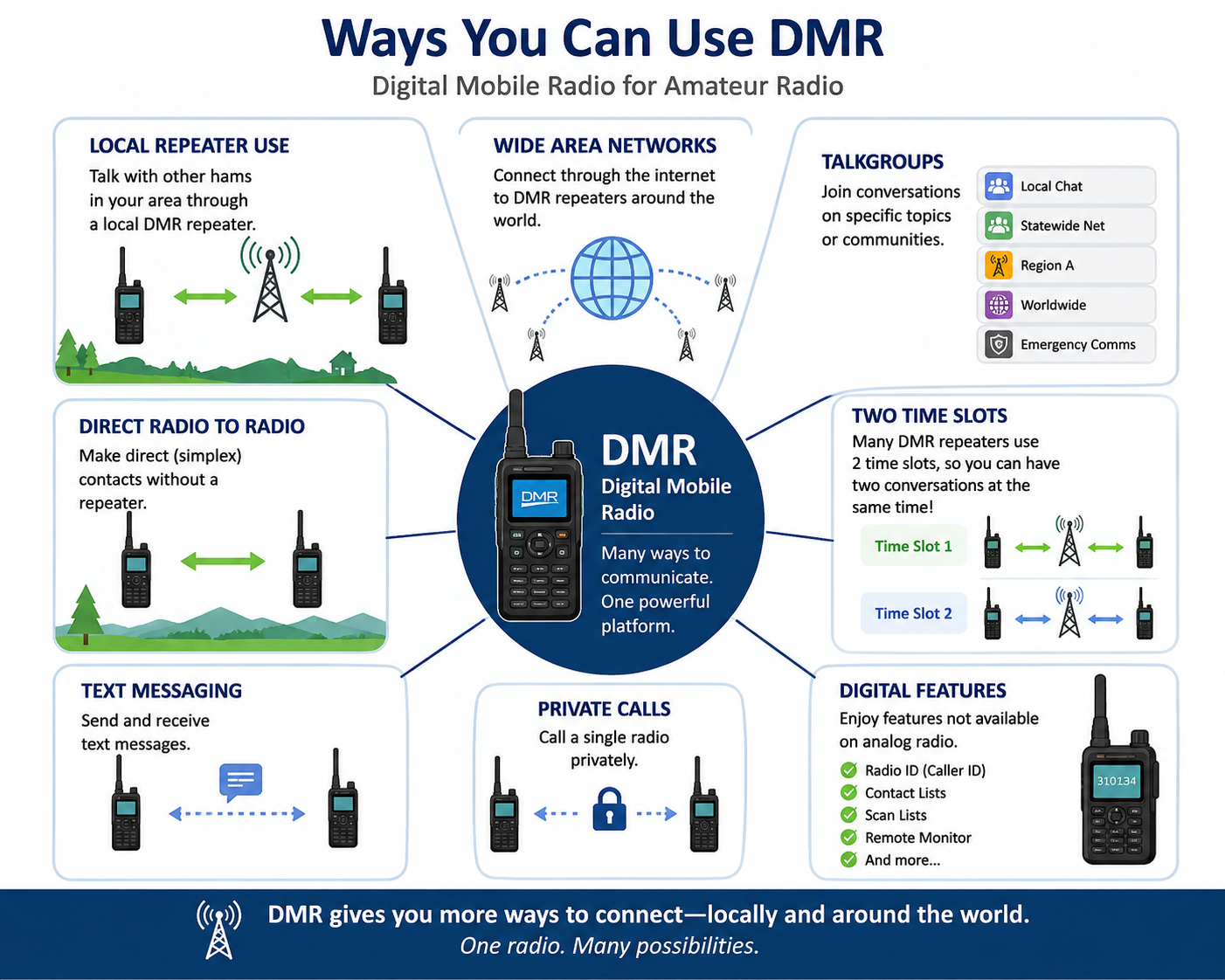
DMR, or Digital Mobile Radio, is a digital voice radio system used by many amateur radio operators, public service groups, businesses, and emergency communication organizations. In ham radio, DMR allows operators to communicate locally through a repeater, directly from radio to radio, or across wide-area networks that link repeaters together over the internet. With the right radio and programming, a handheld or mobile DMR radio can reach local stations, statewide talkgroups, regional networks, and even operators around the world.
The biggest difference between DMR and traditional analog FM radio is how the voice signal is transmitted. Analog radio sends your voice as a continuously varying signal, much like traditional broadcast radio. DMR converts your voice into digital data before transmitting it. Because of this, DMR can provide clear audio, efficient use of repeater bandwidth, and added features such as talkgroups, radio IDs, text messaging, contact lists, and private calling. While analog radio is usually simpler to understand and operate, DMR offers more flexibility once the radio is properly programmed.
One important feature of DMR is the use of talkgroups. A talkgroup is similar to a shared channel or meeting room. Instead of one repeater being used for only one local conversation, DMR repeaters can carry different talkgroups for local, regional, statewide, nationwide, or worldwide communication. Many DMR repeaters also use two time slots, allowing two separate conversations to take place through the same repeater at the same time. This makes DMR an efficient and powerful system, especially where repeater coverage and spectrum space are limited.
A ham radio operator should consider using DMR because it opens up many communication possibilities beyond standard local repeater operation. It can be especially useful for operators who enjoy talking with stations in other areas, participating in nets, learning modern radio technology, or staying connected when local analog activity is limited. DMR does require some learning, especially when it comes to radio programming, codeplugs, talkgroups, color codes, and time slots, but many operators find the added capability well worth the effort.
Analog radio remains an important and reliable part of amateur radio, and it is often the best place for a new operator to begin. DMR is not a replacement for analog, but rather another useful tool in the ham radio toolbox. By learning both analog and digital operation, an amateur radio operator gains more flexibility, more ways to communicate, and a better understanding of how modern radio systems work.