GMRS Introduction
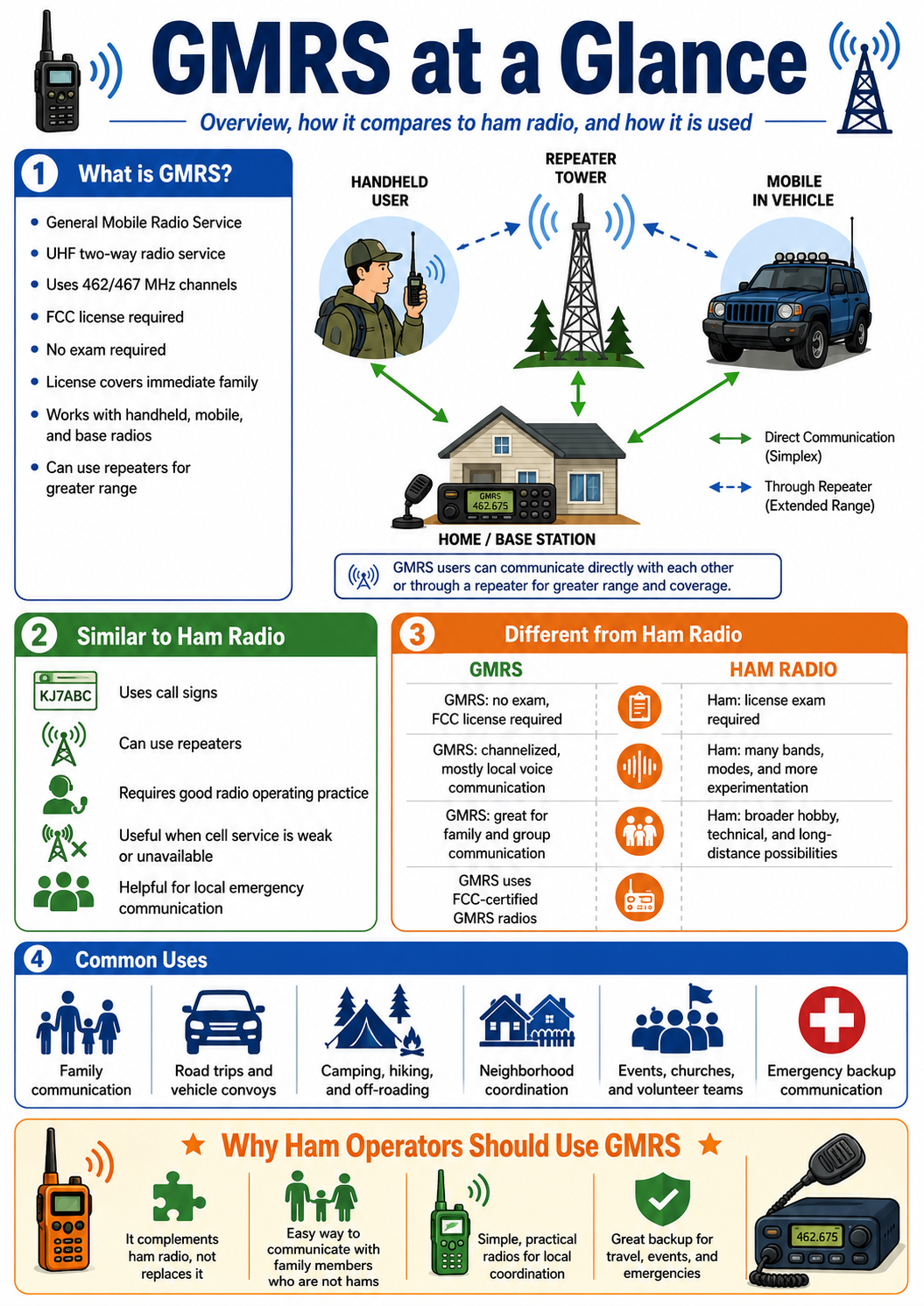
GMRS, or General Mobile Radio Service, is a practical two-way radio service designed for short- to medium-range personal, family, neighborhood, travel, and emergency communications. It operates mainly in the 462/467 MHz UHF range and uses channelized FM voice communications. Unlike ham radio, GMRS does not require an exam, but it does require an FCC individual license. That license is normally valid for 10 years and may cover the licensee’s immediate family members.
GMRS is similar to ham radio in that both services use real radio equipment, antennas, repeaters, call signs, proper operating procedure, and good radio discipline. Both can be very useful when cell service is poor or unavailable, and both are well suited for local emergency communication. GMRS can also use repeaters, and mobile/base stations on the main GMRS channels may operate up to 50 watts, which makes it far more capable than basic FRS walkie-talkies.
The big difference is purpose and flexibility. Ham radio is a broad technical and experimental radio service with many bands, modes, digital systems, worldwide communication, homebuilt equipment, antennas, satellites, HF, VHF, UHF, and emergency-service applications. GMRS is narrower and more practical: it is mostly channel-based local voice communication for families, groups, vehicles, neighborhoods, events, and emergency coordination. GMRS does not allow communication with amateur radio stations, and GMRS transmitters must be FCC-certified for GMRS use.
Ham radio operators should consider using GMRS because it is an excellent companion service. A ham license is individual; your family members cannot simply operate on ham frequencies under your license. GMRS, however, allows eligible family members to operate under the licensee’s GMRS license, making it much easier to keep a household, convoy, camping group, golf outing, church team, or neighborhood group in touch. For a ham operator, GMRS is not a replacement for amateur radio; it is a simple, reliable, and family-friendly tool that fills a gap ham radio was never really intended to fill.