VHF & UHF Basics
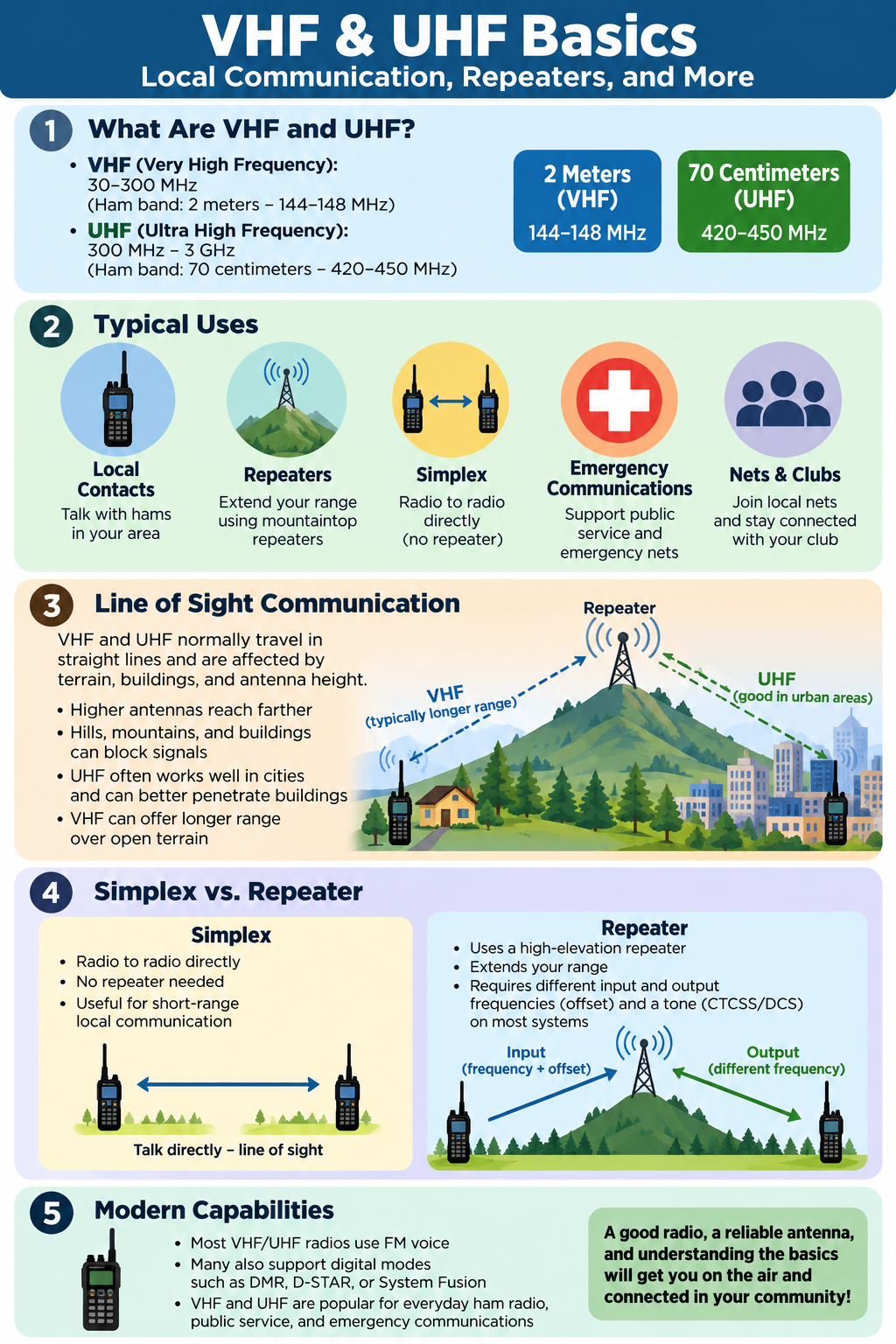
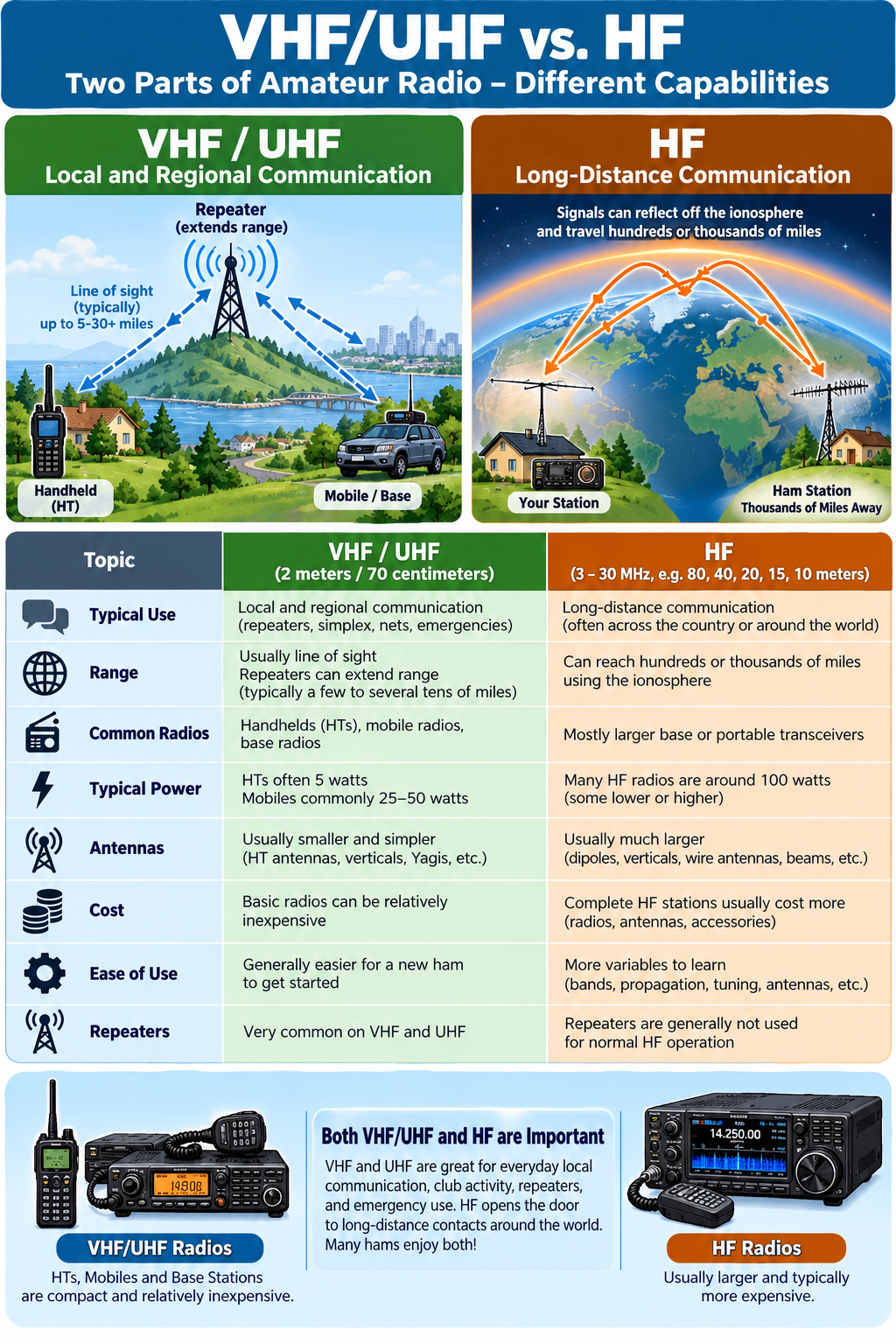
For many amateur radio operators, VHF and UHF are where day-to-day ham radio begins. These bands are commonly used for local and regional communication through repeaters, simplex contacts, emergency communications, public-service activities, and club nets. VHF generally offers somewhat better range over open terrain and can be especially effective for longer local contacts, while UHF often performs well in built-up areas and can penetrate buildings more effectively. Unlike HF, which can use the ionosphere to communicate hundreds or thousands of miles, VHF and UHF communications are normally more dependent on line of sight, antenna height, terrain, buildings, and the location of repeaters. Most local FM voice operation uses either 2 meters (VHF) or 70 centimeters (UHF), and modern radios may also support digital modes such as DMR, D-STAR, or System Fusion. To use these bands effectively, a new operator should understand a few basic ideas: the difference between VHF and UHF, simplex versus repeater operation, repeater input and output frequencies, frequency offsets, CTCSS/DCS tones, proper use of repeaters, and the importance of antenna location. The video below provides a good introduction to these concepts, and the information that follows summarizes the most important points for getting started.
Disclaimer: This independent educational material is not affiliated with, sponsored by, or endorsed by the developers, manufacturers, standards organizations, government agencies, or network operators associated with the technologies and services described.